More Handy Tips
This message came to me from my sister Cindy Morgner, who is recovering after knee surgery.
She calls it- A different kind of challenge.
Hi Sis,
Well I’m sitting here like the queen of the place while others wait on me. Sarah and Keith were here last weekend and fixed/brought food. A number of friends from church have also stopped by with various food items, so it’s been easy on both of us. I am allowed to do “about 10 minutes of KP” at a time, so I can do a few things and Bob takes care of clean-up, etc.
I made a number of meals and soup which I froze in anticipation of surgery, but being on the receiving end of this food-based TLC has led me to think about what to bring to someone in my situation.
I offer the following tips:
Bring something that can be frozen or bring a frozen item as sometimes the food donations are a little front loaded. They can be defrosted and used as needed that way.
Surgery may temporarily modify one’s taste or appetite, stick to simple, nutritious dishes.
Breakfast items are as welcome as lunch or dinner foods.
To the recipient: Label the dishes as soon as you’ve used the item. It doesn’t take long to start playing “musical” Corning Ware.
Remember what tasted good for you when it is time to return the favor.
That’s all from here for now.
Talk to you soon.
C :-0)
Thanks Cindy- glad you are feeling better.
The Challenge: February Picnic
As I get near to 8 weeks of not going to the grocery store things are getting more challenging. Particularly when entertaining. I had company for dinner tonight and decided to make a picnic meal for this chilly February evening. Dinner included cole slaw- from my last head of cabbage, breaded chicken with a cranberry, blackberry and pineapple juice sauce, cornbread with Monterey Jack cheese baked beans and a marinated mixed vegetable salad. I had to rely on the freezer and pantry but things turned out well.
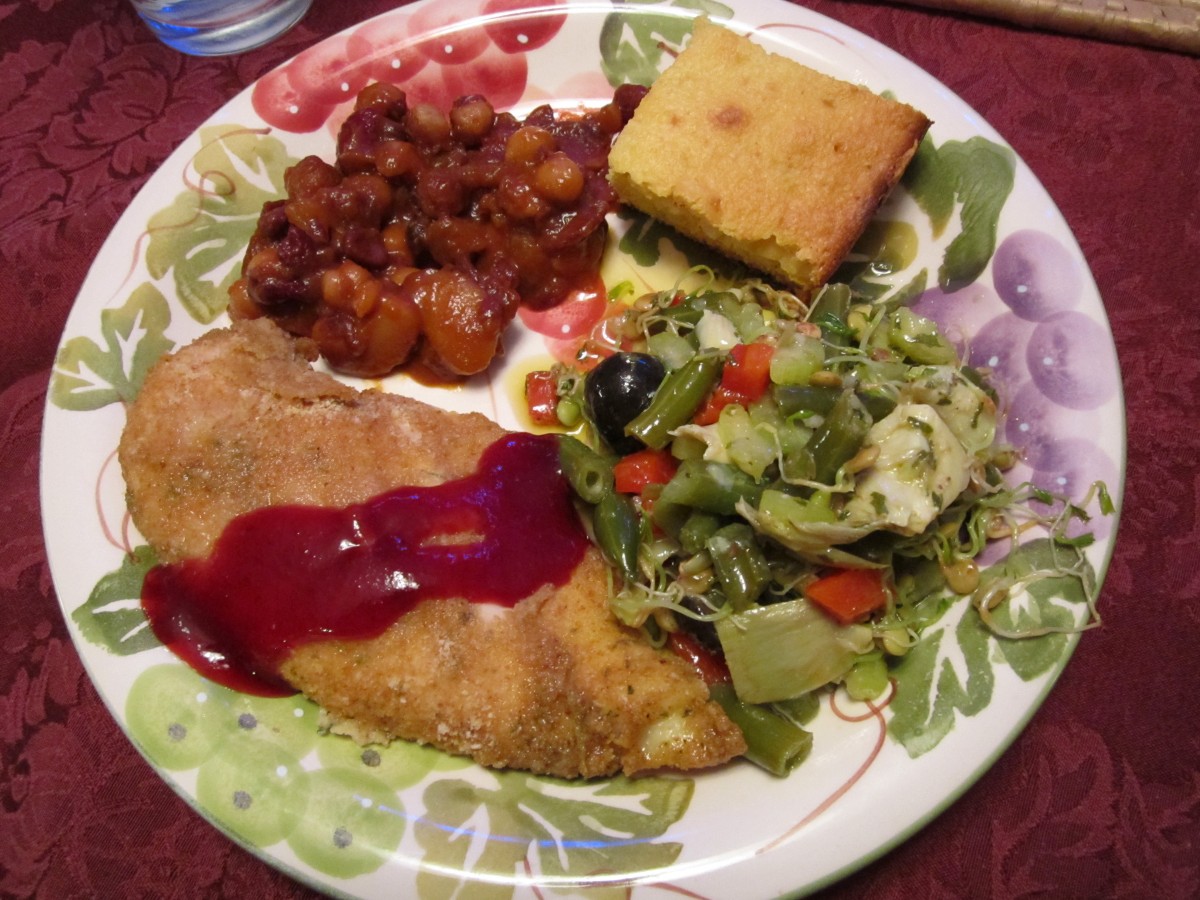 Special thanks to Shelly, Jim, Caroline and Sue for the company and for being such good sports.
The salad was a big hit. I used a can of artichoke hearts, black olives, celery, a red sweet pepper, that I had diced and frozen, frozen green beans and lentil sprouts. For the dressing I used olive oil, red wine vinegar, Tuscan seasoning and salt and pepper.
The Challenge: Don’t waste anything
Earlier today I was cooking rice for a program I have tomorrow. Got a call and forgot about the rice. It was overcooked and I knew I’d have to cook more for tomorrow. The problem is I just didn’t want to toss the rice I had overcooked. Talking with my friend Sue and she suggested rice pudding. Brilliant. Since I have company for dinner this Saturday I am gong to turn this mistake into dessert. Don’t have an exact recipe but I will just mix the rice with milk, eggs and sugar. Toss in some cinnamon and vanilla and we will be good to go. I guess the lesson here is not to be too quick to through it away. I am not talking about food that is left out too long or my be spoiled but food that may need to be re-purposed. Use your imaginations and find a way to save it and use it. I’d like to hear ways you use food creatively that otherwise might be tossed.
Kitchen Hint: Eco-Friendly Drain Cleaner
I found myself with a very sluggish kitchen drain last week in the middle of a very busy day. My pipes under the kitchen sink are fairly new but they are plastic. I never feel right using strong drain cleaners on them. Always like to find a less toxic alternative. I used a combination of baking soda and vinegar and it did the trick. The drain was not completely clogged but really slow. I let the water drain out. Plunging had helped with that. Then I sprinkled baking soda in the drain. I followed that up with a couple of cups of plain white vinegar. It bubbled like crazy and made promising gurgling noises. I waited 15 minutes and flushed the drain with very warm water. Still slow, but better. I let the water drain and repeated the process. The second time resulted in a drain that is well, draining. Good as new. Lost cost, non-toxic, too.
I tried this once on a bathroom sink. When I added the vinegar it bubbled up as expected. What I didn’t expect was a rubber washer in my sink. Some weeks before I had put a new washer in the hot water tap. While getting ready a washer had faller down the drain. I had forgotten about it. When I added the vinegar to the baking soda weeks later it bubbled right out of the drain..
I would love to hear any of your eco-friendly home remedies.
Mardi Gras Recipes
Mardi Gras
Louisiana and New Orleans have a rich tradition that involves some of the best cooking in the world. There are two styles of cooking that the area is famous for, Cajun and Creole. They are similar in that they both took advantage of what was available including rice, seafood, chicken pork and peppers, but there are differences.
Cajuns are of French dissent. Cajuns, from France originally, were living in Nova Scotia and then migrated to Louisiana when the British drove them out in the mid-1700’s. They lived as they had lived in Canada, off the land. They settled largely along waterways and survived by trapping, hunting and fishing. Cajun style cooking is considered country or home style and is solely French in its roots.
Creole cooking specifically developed in New Orleans. During it’s early history the flags of seven different countries flew over New Orleans at various times. Creole is a mix of all these cuisines including French, Spanish, Italian, Native American, African-American and others. As each new group came in the cooks tended to remain. Their skills were highly prized and as they learned to cook for an unfamiliar culture old recipes and techniques would stay. Creole is considered more refined and sophisticated. Where Cajun is country, Creole is definitely city cooking. Whatever the differences, both styles of cooking are wonderful and worth enjoying even if you aren’t in New Orleans.
Creole Spice
1 t. each black, red and white pepper
½ t. thyme
¼ t. dry mustard
¼ t. mace
1 bay leaf, crumbled fine or powdered
Combine all ingredients and store in a cool, dry place. Use sparingly, it is HOT!
Creole Seafood Seasoning
3 T. paprika
3 T. dried minced onion
2 T. salt
2 T. dried minced garlic
1 T. freshly ground black pepper
1 T. cayenne pepper
1 T. dried thyme
Combine all ingredients and store in an airtight container. Great on all types of seafood including shellfish.
Cajun Seasoning
2 T. paprika
2 T. dried thyme
1 T. garlic powder
1 T. dried celery leaves, or dried parsley
1 T. celery seeds
1 T. salt
2 t. cayenne
2 t. freshly ground black pepper
2 t. ground white pepper
Combine all ingredients and store in an airtight container. Great in all sorts of dishes including rice and meat dishes.
Creole Jambalaya
1 lb. smoked sausage, sliced into 1-inch pieces
1 c. chopped onions
2 garlic cloves, chopped
1/4 c. oil
2 c. cubed uncooked chicken
3 c. water
1 1/2 c. uncooked rice
1 16 oz. can tomatoes
2 T. instant chicken base or 6 bouillon cubes
2-3 t. paprika
Cayenne pepper to taste
Black pepper to taste
1/4 t. ground turmeric
1 lb. medium shrimps, peeled and de-veined, uncooked
1 1/2 c. frozen peas
1/2 c. chopped red pepper
1 lb. mussels, optional
In Dutch oven cook sausage, onion and garlic in oil until onion is tender. Add remaining ingredients, except shrimp, peas, sweet red peppers and mussels. Bring to a boil, turn down to simmer and cook 20 minutes. Stir in shrimp, and peppers, cover and cook 10 minutes. Stir in peas and stick in mussels, if desired. Cover and cook 5 more minutes. Discard any mussels that have not opened in 5 minutes. Serves 8.
Roux
Roux is the basis for many dishes in New Orleans cooking. It is a mixture of some sort of fat like butter or oil and flour cooked together and used to thicken sauces. It is the same method for making a white sauce. The difference is that in Cajun and Creole cooking the roux is cooked until it starts to turn color, often until it gets so dark it will almost looked burned. Adds a rich flavor but be careful not to burn it as it will ruin the dish.
Make Your Own Mixes
Been having a chat with my friend Michael today and he was saying that he is trying to be more prepared after reading my blogs. I have been hearing that a lot from a lot of you.
As I look forward to more time without the benefit of the grocery store I started thinking about the mixes and convenience foods we all enjoy so much. A lot of them can be made at home. The disadvantage is the investment of some time. The advantage however is that you have control over the ingredients and you’ll know exactly what you are eating. They can also save you money. So here are some recipes for stuff you can make at home .
Shake-Your-Own Coating Mix
1 ½ c. dry bread crumbs
1 c. flour
1 ½ T. salt
1 T. paprika
1 T. onion powder
1 t. garlic powder
1 t. pepper
6 T. cornmeal
5 T. shortening
Combine all ingredients, except the cornmeal and shortening in a food processor and mix until powdered. Add cornmeal and shortening and pulse until mixture looks orange and crumbly. Store in an airtight container until ready to use.
To use: Place ¾ c. of mixture in a plastic bag. Moisten chicken pieces with a little water or milk and shake off excess. Place pieces one or two at a time in the bake and shake to coat. Bake in a 400-degree oven for 40-50 minutes, or until juices run clear.
Taco Seasoning
4 t. onion powder
3 t. chili powder
1 t. cornstarch
1 t. garlic powder
1 t. cumin
½ t. oregano
1/8 t. cayenne pepper
Mix and store in a cool, dry place. This is the same as 1 packet of taco seasoning mix.
Biscuit Mix -use like Bisquick or Jiffy Mix
8 c. flour
1 c. powdered milk
1 c. powdered buttermilk
1/4 c. baking powder
1 T. salt
1 ½ c. shortening
In large bowl combine dry ingredients and mix well. Cut in shortening until mixture resembles coarse crumbs. Store in a tightly closed container and use in 1-2 months. Makes 10 cups.
Biscuit Mix 2
10 c. flour
½ c. sugar
1/3 c. baking powder
1 T. salt
2 c. shortening
Mix dry ingredients well. Cut in shortening until it resembles coarse crumbs. Store in an airtight container and use within 3 months. Makes 13 cups.
Do You Eat Snow?
I will admit that I ate snow when I was a kid. Can’t remember when the last time was. I’ve been having some interesting conversations lately about water and water quality. One of these conversations with Jonathan last night lead to the eating snow issue. It actually started when I remarked about a video I had seen about a lady making ice cream from snow. Looked cool- but I mentioned that I would not want to eat snow from my urban environment.
He reminded me of how snow is formed. That every snowflake has to form around something to turn into its crystal form. It’s the same way that sugar can become rock candy only when it has that string or stick to form around. These are called nucleators.
It was thought for years that most of the nucleators in snow were dust particles. Actually most of what is in the middle of snowflakes is bacteria and Pseudomonas syringae is the most widespread. It’s a type of bacteria that causes diseases in plants like tomatoes and beans. It is also ubiquitous. There is probably some in your house right now. Especially if you’ve been eating snow!
We know that some bacteria are good for us and others not. From what I have read the experts don’t really agree either. There seemed at least some consensus that infants and people with compromised immune systems should not eat snow. There is also the issue of other pollutants in the air that the flakes can form around.There can be other bacteria as well.
There is also a group of folks who think we coddle our kids too much. They think rather than treat kids like hot-house orchids we should expose them to more dirt, more bacteria to build up their immune systems. I see their logic, too. Polio was in part the result of a generation of children raised in nearly germ-free environments. The thought of the time was that all bacteria were bad- and a germ free world was what kids needed. Left the kids’ bodies unprepared for battle, so to speak. If you travel out of the country you have likely been somewhere where you are advised to not drink the water. The locals do. Their systems have become accustomed to the bacteria found in their environments.
So that still leaves the question- Would you eat snow?
The Challenge: Getting Creative
I can’t believe it has already been 45 days since I went to the grocery store. I have to admit it is getting harder but I am hanging in. I do find it most difficult when entertaining. I so want to go get fresh produce and I have a craving for lettuce that borders on obsession. The other day I had company for dinner. Soup is still pretty easy for me to produce but I needed dessert. Hmmm.
I had some tortillas in the freezer and I still have fresh apples so I turned them into a sort of blintz. I peeled and sliced a couple of apples and sliced them into strips. I sauteed them in a little butter and then added just a tablespoon of water and some brown sugar and cinnamon. The tortillas had some dryness from being frozen so I soaked them in water for a few minutes. Milk would have worked, too. I rolled the apple mixture in the tortillas and browned them in a skillet in butter. Dusted with powdered sugar and tada- dessert.  Thanks again for all the feedback. Plan to hold out at least until March 1. May go for April 1st but still thinking about that one.
Whole Wheat Sour Dough Bread
I decided last night that I wanted to bake bread today. Hadn’t made sour dough bread in a long time so I thought it sounded like a good idea. The bread turned out great. I didn’t even wait for it to cool down before cutting the first slice. You will note the ragged edge on the bread.
I am including a recipe for this bread- well sort of. I didn’t actually use a recipe. Here is what I did. I mixed 2 cups of warm water with 2 packages of active dry yeast. Then I stirred in 1/4 cup of brown sugar and about 2 cups of whole wheat flour. I mixed well by hand, covered the bowl with a towel and left it on the kitchen counter overnight. Late this morning I added 2 teaspoons of salt, 1/4 cup of olive oil and stirred that in well. Then I just started adding whole wheat flour- about 1/4 cup at a time until the dough started to come away from the edge of the bowl. On a floured surface I kneaded to dough for about 5 minutes and placed it back in the bowl. I covered the bowl with the towel and let the dough double in size. hat took about 90 minutes. Then I divided the dough in half and on a lightly floured surface i shaped the dough into 2 loaves and placed in greased 9×5-inch loaf pans. I brushed the loaves with a little oil, covered them with the towel and let them double again- about 60 minutes. Then I baked them in a preheated 350 degree oven for about 35 minutes.

The Challenge: The Fridge
Funny how when a storm approaches we all run to the store to stock up. It was strange not to do that yesterday. I have what I need already but I must admit it was odd not to join the long lines at the store. By most standards it has been a mild winter around here. Periods of cold, but short lived. I am starting 7 weeks now of not going to the grocery store. So far, so good. I will not say it has been easy all the time. There are foods I miss like oranges and fresh berries but I did put away plenty of food in the freezer and I have dehydrated fruits and vegetables and canned goods, both homemade and store bought.
In the interest of not being wasteful, which is part of the reason for this little experiment, I have become much better at keeping up with the fridge. Unlike the pantry and freezer which can do with a good clean out and inventory about once a year, the fridge needs more constant watching.
Generally speaking you should give the fridge a good look about once a week. That means checking the nooks and crannies that can get away from us all. Check the produce drawer well. We have all had the experience of finding some formless blob in the bottom that looks like a science experiment gone bad. It really only takes about 5 minutes to do this. Keep after perishable foods with some diligence.
If you have more of what you can or want to eat in a few days try freezing it. I think this matters even more for smaller households. Even our favorite foods can get boring too many days in a row. I know when I get started making a vegetable soup, what started as a little pan turns into a vat pretty quickly. It tastes great but to eat it up before it goes bad I’d be looking at eating for breakfast, lunch and dinner. Remember, though, to label everything you freeze and to keep an inventory of what is in the freezer. The nice thing about freezing the leftovers is the ready meal you have on those days when you might not have time to cook.
Trying an experiment here today. As you may have read in earlier posts I am to the point where I must bake bread if I want it. I have made sour dough bread before, but not in a long time. I decided to start a batch last night. I combined 2 cups of warm water with 2 packages of yeast, a little brown sugar and about 2 cups of whole wheat flour. I mixed it all up and left it in a towel-covered bowl on the counter overnight. I’ll add some oil, salt and more flour in a little while and eventually should have 2 loaves of whole wheat sour dough bread. I’ll let you all know how it turns out.
Thanks for all the feedback and support. I will hold out until March 1st and I may even try for April. Well, maybe not. The sprouting has been a great help. I only wish I would have started more of the alfalfa. I am really loving them but go through them quickly and it takes a bout a week for another crop. Also starting lentil sprouts this week. I’ll let you know how that works out. 🙂