Make Your Own Mixes
Been having a chat with my friend Michael today and he was saying that he is trying to be more prepared after reading my blogs. I have been hearing that a lot from a lot of you.
As I look forward to more time without the benefit of the grocery store I started thinking about the mixes and convenience foods we all enjoy so much. A lot of them can be made at home. The disadvantage is the investment of some time. The advantage however is that you have control over the ingredients and you’ll know exactly what you are eating. They can also save you money. So here are some recipes for stuff you can make at home .
Shake-Your-Own Coating Mix
1 ½ c. dry bread crumbs
1 c. flour
1 ½ T. salt
1 T. paprika
1 T. onion powder
1 t. garlic powder
1 t. pepper
6 T. cornmeal
5 T. shortening
Combine all ingredients, except the cornmeal and shortening in a food processor and mix until powdered. Add cornmeal and shortening and pulse until mixture looks orange and crumbly. Store in an airtight container until ready to use.
To use: Place ¾ c. of mixture in a plastic bag. Moisten chicken pieces with a little water or milk and shake off excess. Place pieces one or two at a time in the bake and shake to coat. Bake in a 400-degree oven for 40-50 minutes, or until juices run clear.
Taco Seasoning
4 t. onion powder
3 t. chili powder
1 t. cornstarch
1 t. garlic powder
1 t. cumin
½ t. oregano
1/8 t. cayenne pepper
Mix and store in a cool, dry place. This is the same as 1 packet of taco seasoning mix.
Biscuit Mix -use like Bisquick or Jiffy Mix
8 c. flour
1 c. powdered milk
1 c. powdered buttermilk
1/4 c. baking powder
1 T. salt
1 ½ c. shortening
In large bowl combine dry ingredients and mix well. Cut in shortening until mixture resembles coarse crumbs. Store in a tightly closed container and use in 1-2 months. Makes 10 cups.
Biscuit Mix 2
10 c. flour
½ c. sugar
1/3 c. baking powder
1 T. salt
2 c. shortening
Mix dry ingredients well. Cut in shortening until it resembles coarse crumbs. Store in an airtight container and use within 3 months. Makes 13 cups.
Do You Eat Snow?
I will admit that I ate snow when I was a kid. Can’t remember when the last time was. I’ve been having some interesting conversations lately about water and water quality. One of these conversations with Jonathan last night lead to the eating snow issue. It actually started when I remarked about a video I had seen about a lady making ice cream from snow. Looked cool- but I mentioned that I would not want to eat snow from my urban environment.
He reminded me of how snow is formed. That every snowflake has to form around something to turn into its crystal form. It’s the same way that sugar can become rock candy only when it has that string or stick to form around. These are called nucleators.
It was thought for years that most of the nucleators in snow were dust particles. Actually most of what is in the middle of snowflakes is bacteria and Pseudomonas syringae is the most widespread. It’s a type of bacteria that causes diseases in plants like tomatoes and beans. It is also ubiquitous. There is probably some in your house right now. Especially if you’ve been eating snow!
We know that some bacteria are good for us and others not. From what I have read the experts don’t really agree either. There seemed at least some consensus that infants and people with compromised immune systems should not eat snow. There is also the issue of other pollutants in the air that the flakes can form around.There can be other bacteria as well.
There is also a group of folks who think we coddle our kids too much. They think rather than treat kids like hot-house orchids we should expose them to more dirt, more bacteria to build up their immune systems. I see their logic, too. Polio was in part the result of a generation of children raised in nearly germ-free environments. The thought of the time was that all bacteria were bad- and a germ free world was what kids needed. Left the kids’ bodies unprepared for battle, so to speak. If you travel out of the country you have likely been somewhere where you are advised to not drink the water. The locals do. Their systems have become accustomed to the bacteria found in their environments.
So that still leaves the question- Would you eat snow?
The Challenge: Getting Creative
I can’t believe it has already been 45 days since I went to the grocery store. I have to admit it is getting harder but I am hanging in. I do find it most difficult when entertaining. I so want to go get fresh produce and I have a craving for lettuce that borders on obsession. The other day I had company for dinner. Soup is still pretty easy for me to produce but I needed dessert. Hmmm.
I had some tortillas in the freezer and I still have fresh apples so I turned them into a sort of blintz. I peeled and sliced a couple of apples and sliced them into strips. I sauteed them in a little butter and then added just a tablespoon of water and some brown sugar and cinnamon. The tortillas had some dryness from being frozen so I soaked them in water for a few minutes. Milk would have worked, too. I rolled the apple mixture in the tortillas and browned them in a skillet in butter. Dusted with powdered sugar and tada- dessert.  Thanks again for all the feedback. Plan to hold out at least until March 1. May go for April 1st but still thinking about that one.
Whole Wheat Sour Dough Bread
I decided last night that I wanted to bake bread today. Hadn’t made sour dough bread in a long time so I thought it sounded like a good idea. The bread turned out great. I didn’t even wait for it to cool down before cutting the first slice. You will note the ragged edge on the bread.
I am including a recipe for this bread- well sort of. I didn’t actually use a recipe. Here is what I did. I mixed 2 cups of warm water with 2 packages of active dry yeast. Then I stirred in 1/4 cup of brown sugar and about 2 cups of whole wheat flour. I mixed well by hand, covered the bowl with a towel and left it on the kitchen counter overnight. Late this morning I added 2 teaspoons of salt, 1/4 cup of olive oil and stirred that in well. Then I just started adding whole wheat flour- about 1/4 cup at a time until the dough started to come away from the edge of the bowl. On a floured surface I kneaded to dough for about 5 minutes and placed it back in the bowl. I covered the bowl with the towel and let the dough double in size. hat took about 90 minutes. Then I divided the dough in half and on a lightly floured surface i shaped the dough into 2 loaves and placed in greased 9×5-inch loaf pans. I brushed the loaves with a little oil, covered them with the towel and let them double again- about 60 minutes. Then I baked them in a preheated 350 degree oven for about 35 minutes.

The Challenge: The Fridge
Funny how when a storm approaches we all run to the store to stock up. It was strange not to do that yesterday. I have what I need already but I must admit it was odd not to join the long lines at the store. By most standards it has been a mild winter around here. Periods of cold, but short lived. I am starting 7 weeks now of not going to the grocery store. So far, so good. I will not say it has been easy all the time. There are foods I miss like oranges and fresh berries but I did put away plenty of food in the freezer and I have dehydrated fruits and vegetables and canned goods, both homemade and store bought.
In the interest of not being wasteful, which is part of the reason for this little experiment, I have become much better at keeping up with the fridge. Unlike the pantry and freezer which can do with a good clean out and inventory about once a year, the fridge needs more constant watching.
Generally speaking you should give the fridge a good look about once a week. That means checking the nooks and crannies that can get away from us all. Check the produce drawer well. We have all had the experience of finding some formless blob in the bottom that looks like a science experiment gone bad. It really only takes about 5 minutes to do this. Keep after perishable foods with some diligence.
If you have more of what you can or want to eat in a few days try freezing it. I think this matters even more for smaller households. Even our favorite foods can get boring too many days in a row. I know when I get started making a vegetable soup, what started as a little pan turns into a vat pretty quickly. It tastes great but to eat it up before it goes bad I’d be looking at eating for breakfast, lunch and dinner. Remember, though, to label everything you freeze and to keep an inventory of what is in the freezer. The nice thing about freezing the leftovers is the ready meal you have on those days when you might not have time to cook.
Trying an experiment here today. As you may have read in earlier posts I am to the point where I must bake bread if I want it. I have made sour dough bread before, but not in a long time. I decided to start a batch last night. I combined 2 cups of warm water with 2 packages of yeast, a little brown sugar and about 2 cups of whole wheat flour. I mixed it all up and left it in a towel-covered bowl on the counter overnight. I’ll add some oil, salt and more flour in a little while and eventually should have 2 loaves of whole wheat sour dough bread. I’ll let you all know how it turns out.
Thanks for all the feedback and support. I will hold out until March 1st and I may even try for April. Well, maybe not. The sprouting has been a great help. I only wish I would have started more of the alfalfa. I am really loving them but go through them quickly and it takes a bout a week for another crop. Also starting lentil sprouts this week. I’ll let you know how that works out. 🙂
Chocolate Recipes
With Valentine’s day just around the corner I’d like to share some of my favorite chocolate recipes with you. Personally I don’t think we need a holiday to enjoy chocolate. The first recipe is for a flour-free cake that is dense and rich. The pound cake recipe is a nice twist on a classic. The shortbread cookies are always a big hit when I make them- I think you’ll love them, too. enjoy!
Flourless Chocolate Mousse Cake
½ c. each sugar and water
1 stick butter
12 oz. semi sweet chocolate
6 eggs
¼ dark rum or other liqueur
Butter an eight inch cake pan and line with parchment. In saucepan heat together water and sugar until they boil. Stir in butter and bring to boil. Remove from heat and stir in chocolate until melted. Beat in eggs until smooth and stir in rum. Pour batter into prepared pan and place pan in a roasting pan. Pour boiling water into roaster to come up sides of pan 1 inch. Bake in a preheated 325 degree oven for 45 minutes. Cool, invert onto plate.
Serve cake topped with whipped cream and decorate with raspberries, other fresh fruit or even toasted nuts. Dense and rich this cake serves 8-10.
Chocolate Pound Cake
1 c. cocoa
2 c. flour
1/2 t. baking powder
1 t. salt
2 T. instant coffee powder
3 sticks butter
3 c. sugar
2 t. vanilla
5 eggs
1 c. buttermilk
1/4 c. water
Preheat oven to 325-degrees. Grease and flour a 10-inch tube pan. Sift together dry ingredients and set aside. Cream butter with mixer until smooth. Add sugar slowly while beating. Beat at high speed for 5 minutes. Stir in vanilla and beat in eggs one at a time beating briefly after each addition. Beat in flour mixture alternately with the liquid. Beat until batter is smooth and pour into prepared pan. Bake in top third of oven for 1 hour and 20 minutes or until tester comes out clean. Let cake rest in pan 20 minutes before inverting onto plate.
Chocolate Shortbread
1 c. butter, room temperature
3/4 c. sugar
2 c. flour
1/3 c. cocoa
1/4 t. salt
8 oz. semi-sweet chocolate
Beat together butter and sugar until well blended. Mix together dry ingredients and slowly beat into butter mixture, stirring it in at the end. Line a cookie sheet with foil or parchment and press dough out on prepared sheet into a 12×6- inch rectangle that’s about 1/2 inch thick. Bake in a 325-degree oven for 30 minutes. Cool on sheet 5 minutes. Trim edges to make straight and cut into 3×1-inch rectangles. Cool on rack. Melt chocolate and dip cookies in it. Place on wax paper until firm. Makes 24-28 bars.
The Challenge: Being Prepared
If there were a natural disaster how long would you be able to go without getting to the store? Since I have not been going to the grocery store for over a month now I have been getting a lot of comments pertaining to this. Carl Skalak from Blue Pike Farm sited a book he has which said that in the average town there is a 3 day supply of food in the stores. Mari Keating from Food Not Lawns mentioned at dinner last night that she heard it was even less than 3 days. We’ve all seen the pictures of stores when hurricanes or big snow storms are predicted. The lines are long and the shelves are bare in no time at all.
Living off stored foods has been an eye opening experience for me. I don’t take anything for granted. I am careful not to waste a thing. Also makes me happy that I canned, dehydrated and froze as much stuff as I did. Opens the conversation to more questions. How much water do you have? What if there were a boil alert or the water stopped running? What if the power went out?
I am not trying to be an alarmist. I am actually a pretty sunny person, but I do think we all need to think more about the “what ifs?”. Maybe the Boy Scout motto to “Be Prepared” is a lesson for us all.
So I’d like to hear from you. Do you think about what you would do if there was no food available at the store? How long could you and your family go before resources run out? Is it something you even think about?
The Challenge: Baking Bread / Swedish Limpa
Sometimes its the little things that you forget. Since I am committed to not going to the grocery store there are things I am bound to run out of. I have baked bread before- since I ran out a few weeks ago. Was thinking about it a few days ago. Hmmmm. I am out of bread.
Wanted toast this morning when it hit me. I never made the bread. Running to the store if we want bread is something we kind of take for granted. Not too many generations ago if you wanted bread you had to make it. The thing is my Dad was a baker, my Mom always baked bread and I love to make homemade bread. Well, if I want toast tomorrow morning I will have to get it done. Just a matter of which type to make. I finally decided on Swedish Limpa. It’s a rye bread with orange peel, caraway seeds and a little brown sugar. it is also a favorite of my brother-in-law, Bob. His Swedish Mom used to make it. So as I get ready to make the bread I will be thinking of Bob. Here is the recipe in case you want to try it, too.
Swedish Limpa
6 ½ c. flour
2 c. rye flour
¼ c. brown sugar
2 t. salt
2-t. caraway seeds
2 t. grated orange peel
2 pkt. Active dry yeast
2 T. margarine, softened
2 2/3 c. hot water (125-130 degrees)
Set aside 1-cup flour. Mix remaining flours and other dry ingredients in a large bowl. Add margarine and water to flour mixture and stir to blend. Mix in enough additional flour to make a soft dough. Knead on a floured surface until smooth about 8-10 minutes. Place dough in oiled bowl turning to oil top. Cover and let rest in a draft free area until doubled, about 30 –40 minutes. Punch down. Divide dough in half and form into 2 balls. Place on greased baking sheet and cover until doubled in bulk, about 30 –40 minutes. Bake in a preheated 400-degree oven for 30 minutes or until bread sounds hollow when tapped lightly. Makes 2 loaves.
More Cooking Tips
Thanks for the input from my post on favorite cooking tips. I got a couple more I wanted to share with you.
I mentioned a tip earlier about using cold water to clean up flour. My sister, Cindy Morgner in Central Lake, Michigan sent me this tip that is related.
Cindy Wrote: Another time for starting clean up with cold water is when preparing raw meat, chicken or seafood. I like to give my knives and cutting board a good cold water rinse before washing with hot, soapy water. The rationale is the same as for the flour: you don’t want to “cook” those juices onto your cutting board. Ugh!
My niece Sarah, also shared a good tip. When using a jar of pasta sauce use wine to rinse out what is left in the jar. That way the wine adds extra flavor to the dish. I love this tip- I normally use water. Thanks, Sarah.
Marilyn said she likes to wash and spin dry salad greens ahead of time and chill before using. Makes then extra crispy.
Keep the ideas coming. I have enjoyed reading them and will post more soon. 🙂
The Challenge: Sprouting Seeds
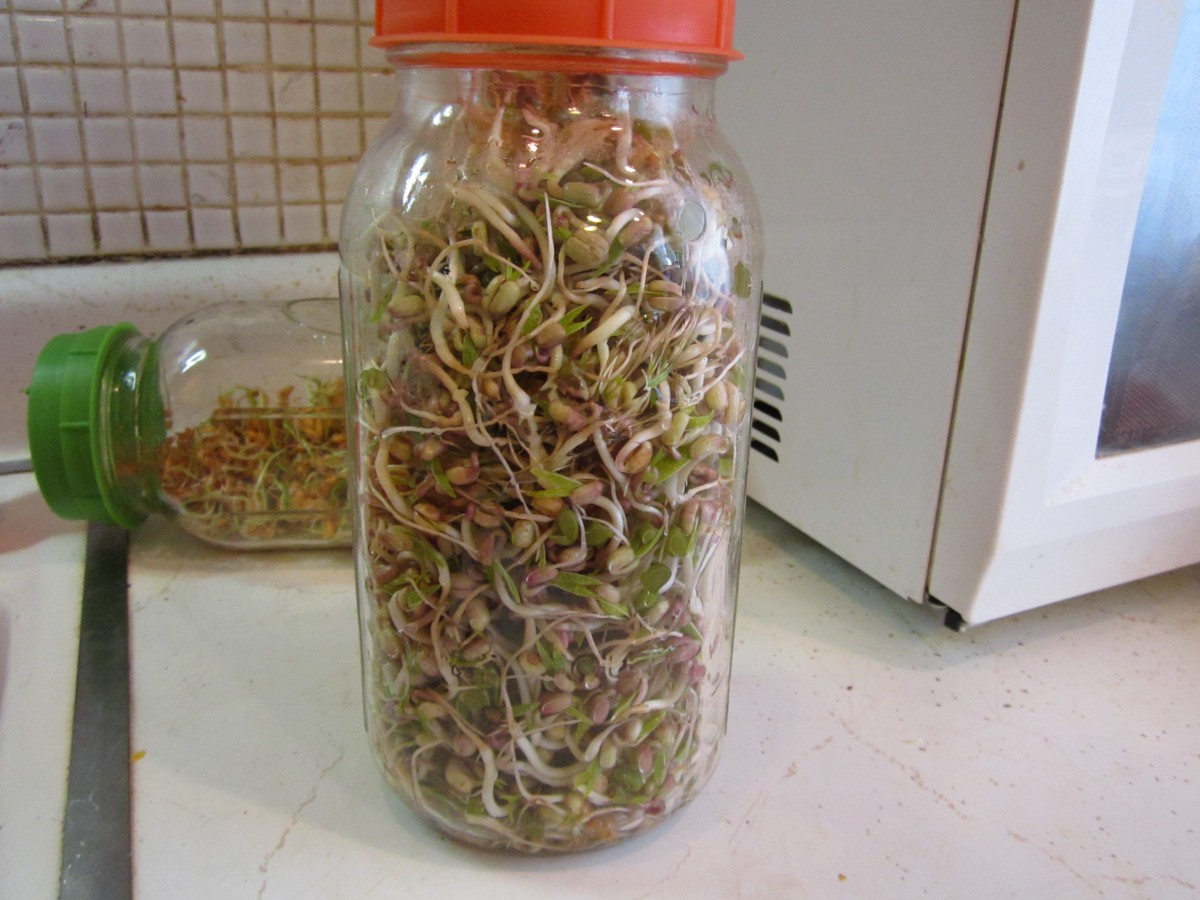
Mung Beans- a week old.
In an effort to have fresh produce even if I wasn’t going to the grocery store I invested in some seeds for sprouting. Its been a lot of fun so far. I purchased seeds of alfalfa, radish, peas, mung beans, adzuki beans, triticale, lentils and garbanzo beans. So far I have sprouted the peas- which I used in a stir fry for company a couple of weeks ago. Currently have seeds for mung beans and triticale sprouting and almost ready for harvest.
Sprouting is pretty simple- although it is a little like having a pet. There is some care than needs to happen. First, start with a clean, wide mouth jar. I have these handy lids with holes in them that are made just for sprouting. Place the seeds in the jars and cover with water. Allow them to be covered in the water for at least overnight. Drain and rinse the seeds. After the first soaking only keep what ever water stays on them after a rinse and drain. That’s pretty much the whole process. Twice a day, maybe three times if the weather is really warm, rinse the seeds and drain off any extra water. Depending on the seeds you can expect your first crop in 7-10 days. You can place the jars in a sunny window for greener sprouts.
Sprouts are full of nutrients and can be eaten cooked or raw. In some cases, like with mung beans the skin of the seed will come off after a few days. They tend to float so if you just place the sprouts in a big bowl of fresh water and agitate them. The skins will come to the top and can easily be discarded.
Also, quantity can be tricky. Very few seeds can produce a heck of a lot of sprouts so go easy. A few tablespoons of tiny seeds like radish, alfalfa or broccoli should be plenty. Perhaps a 1/4 cup of larger seeds like the beans and other legumes is also going to give you a bountiful supply. They do take time so if you want a steady supply start a new batch every few days. Once sprouts are the size you want them to be give them a final rinse and drain well. Store in the fridge until you are ready to use them. Do use them soon. Often they are quite perishable. Besides, if you were sprouting for fresh food- enjoy it while it is fresh.
This ones for you, Keith. 🙂
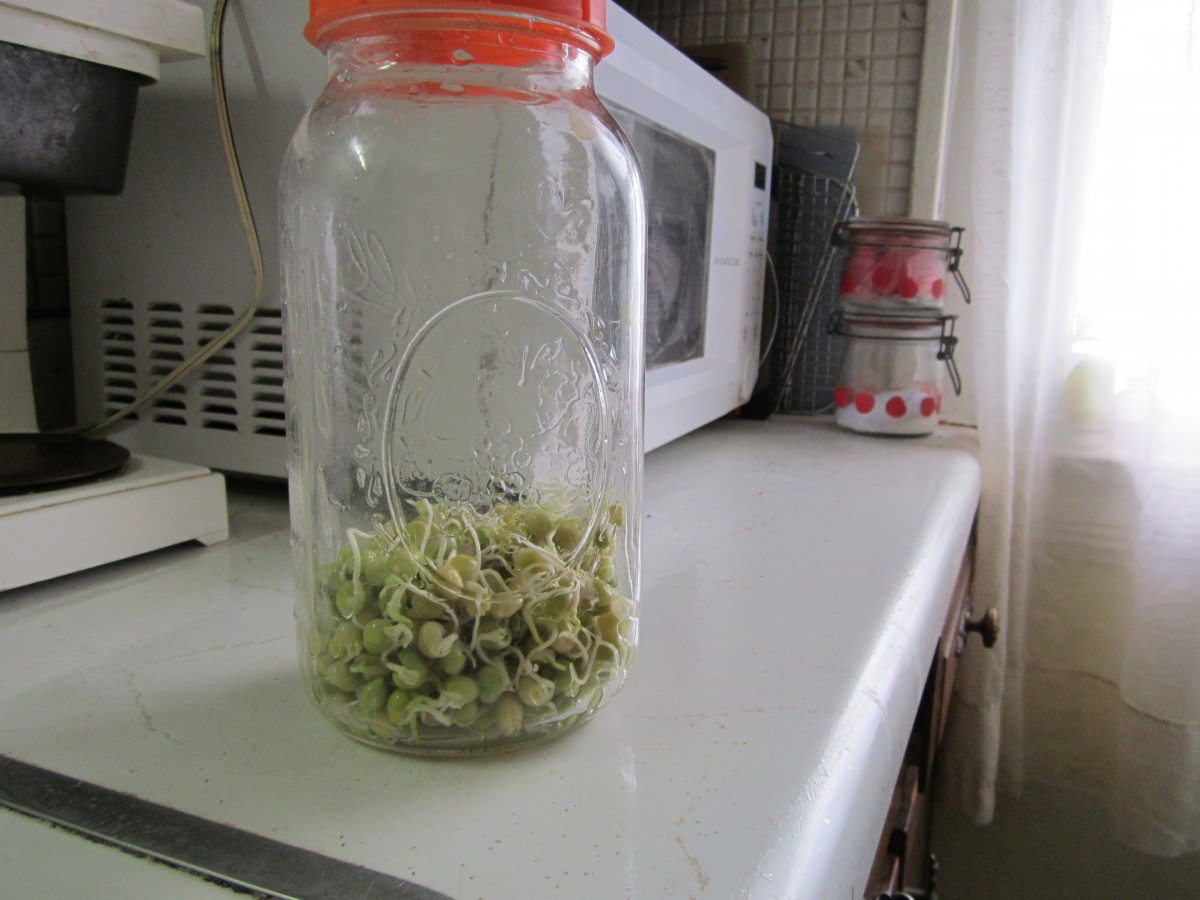
Pea sprouts- about 4 days old.