Wine and Tequila Punch


I would never have thought that combining tequila and wine would taste so good, but it really is a great drink for parties. I had a request for this recipe, and I am going to share it with you, the best that I can.
I normally am pretty good about measuring ingredients and writing things down, but a friend actually made it.
My friend Sue, is a very good cook. She has great instincts when it comes to flavors. She is also lovingly known as the Queen of Substitutions. She will start with a recipe and then just add what she has on hand. Often things work out, sometimes, not.
This is one of those times when things worked out very well, indeed. She was watching TV and saw a recipe for a tequila and wine punch. She had the tequila and wine, but not quite all of the other ingredients, so she kind of made it up as she went along. The end result was a drink that was not too sweet and very refreshing. This would be fun to make for a Labor Day party.
So here is the recipe.
Wine and Tequila Punch
1 1/2 c. tequila
1/2 bottle of wine, use what you have on hand, Sue did
1 c. margarita mix
1 c. orange juice
1 or 2 oranges, sliced thin
ice
In pitcher, combine tequila with wine, mix, juice and oranges. Add lots of ice, stir and serve.
Cucumbers and Sour Cream

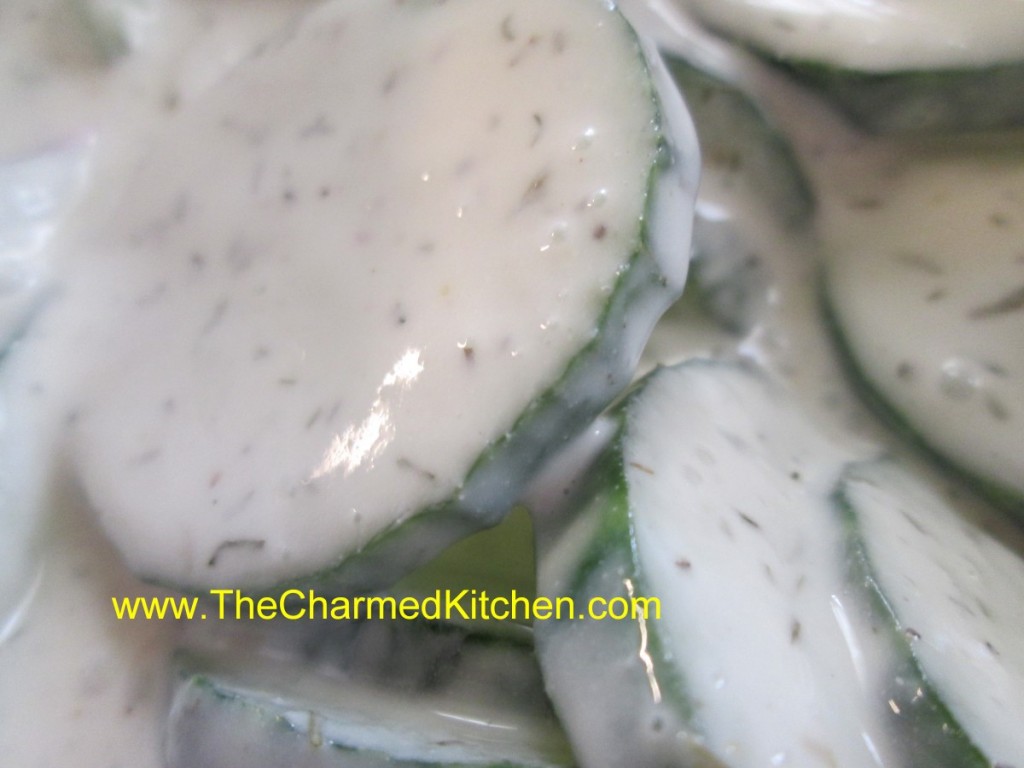
It was one of the first dishes I can remember helping my Mother make. She let me slice the cucumbers and mix the dressing. It seemed we often had it on the weekends when my Father was grilling. I can’t make this salad without thinking of the wonderful smells wafting into the kitchen from that grill.
You can use any type of cucumber you like in this recipe. English cucumbers don’t have to be peeled. You might want to peel cucumbers with tougher skins.
Cucumbers and Sour Cream
2-3 medium cucumbers, sliced
1 c. sour cream or strained yogurt
¼ c. sugar
¼ c. vinegar
2 green onions, chopped
1 –2 T. chopped fresh dill or 1-2 t. dried
Combine all ingredients and chill at least 15 minutes. Serves 6-8.
Coconut Shrimp


Coconut shrimp is a favorite of mine, and pretty easy to make. Cleaned, raw shrimp are dredged in flour, egg wash and a Panko bread crumb-coconut mix, then fried. I add some homemade curry powder to the eggs, for a little extra flavor.
You can serve coconut shrimp as an appetizer or over rice as a main dish. I serve mine with a sweet chili sauce.
Eating shrimp always feels like a splurge or a special occasion. I think that started in my childhood. We didn’t eat shrimp often when I was a kid. Only a few times a year, always a special occasion.
As an adult I have learned to enjoy shrimp a lot of different ways. I eat it more often now, but it still feels special.
Here is my recipe for coconut shrimp. You don’t need a special occasion to make it.
Coconut Shrimp
2 cups oil – I like to use peanut oil or avocado oil
1 cup Panko bread crumbs
1 cup unsweetened shredded coconut
1 pound shrimp, peeled and deveined
Kosher salt and freshly ground black pepper, to taste
1/2 cup all-purpose flour
2 large eggs, beaten
1-2 t. curry powder, or to taste
Heat oil in a large skillet or Dutch oven over medium high heat. In a large bowl, combine Panko bread crumbs and shredded coconut; set aside. Combine eggs with curry powder, set aside. Season shrimp with salt and pepper, to taste. Working one at a time, dredge shrimp in the flour, dip into the egg mixture, then dredge in the coconut mixture, pressing to coat. Working in batches, add shrimp to the Dutch oven and fry until evenly golden brown and crispy, about 2-3 minutes. Transfer to a paper towel-lined plate. Serve immediately with sweet chili sauce, if desired. Serves 4.
Versatile Bean Dip

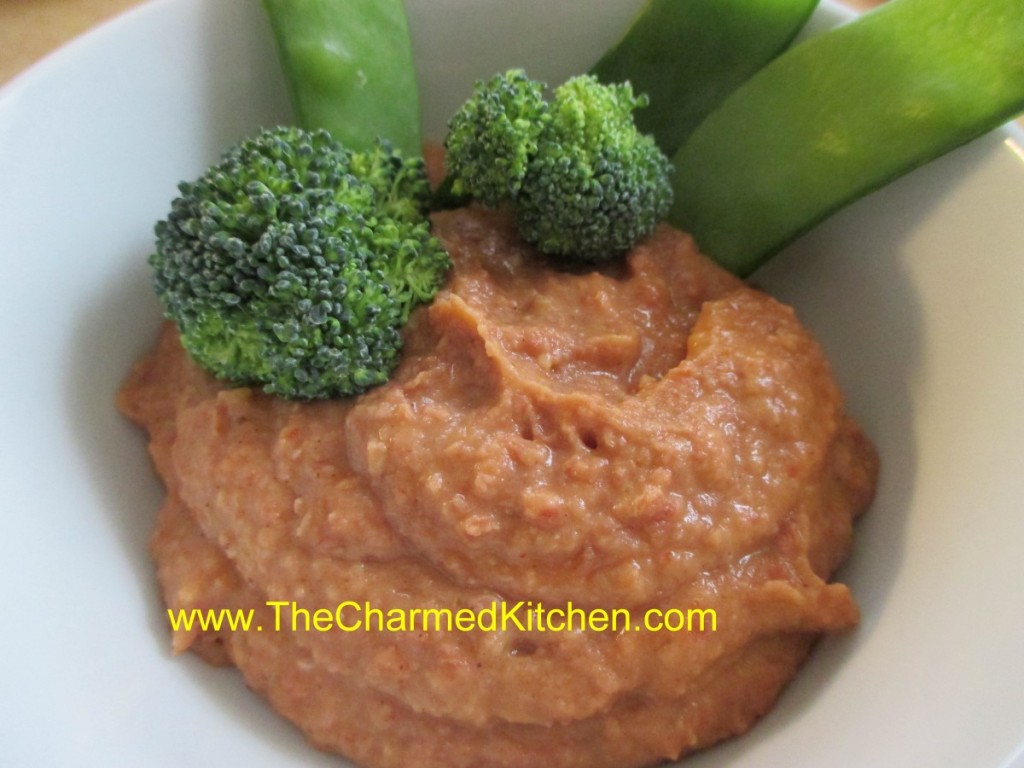
If you only use bean dip as an appetizer you are really missing out. Bean dip is often served with chips and veggies and it is always a hit. But, it can be used for a lot more than that.
Certainly in other Tex-Mex dishes like burritos or enchiladas. I like to spread it on fresh tortillas and top with cheese, chopped peppers, onions and olives- then bake until hot and cheese has melted. It can also be spread inside pita bread and then the bread filled with sprouts or sliced veggies for a quick sandwich. You can also add the bean dip to hot cooked veggies like corn, green beans, or carrots, in place of, or in addition to, the butter. It also can be added to stir-fries for extra flavor or to soup as a thickener. I sometimes add it to chili, too. I often make a big batch and freeze some for later use.
Bean Dip
2 cans kidney beans, drained and rinsed – you can use other beans
1 c. salsa, store bought or homemade
¼ c. olive oil
2 T. cider vinegar
2 t. chili powder
1 t. cumin
Healthy dash of hot sauce
Salt and pepper to taste
In food processor blend all ingredients until smooth. I usually start the beans first for 30 seconds or so and then add everything else. If you want it thinner you can add some extra oil. Makes 3 cups. Freezes well.
Kat’s Extra Wonderful Mustard Sauce

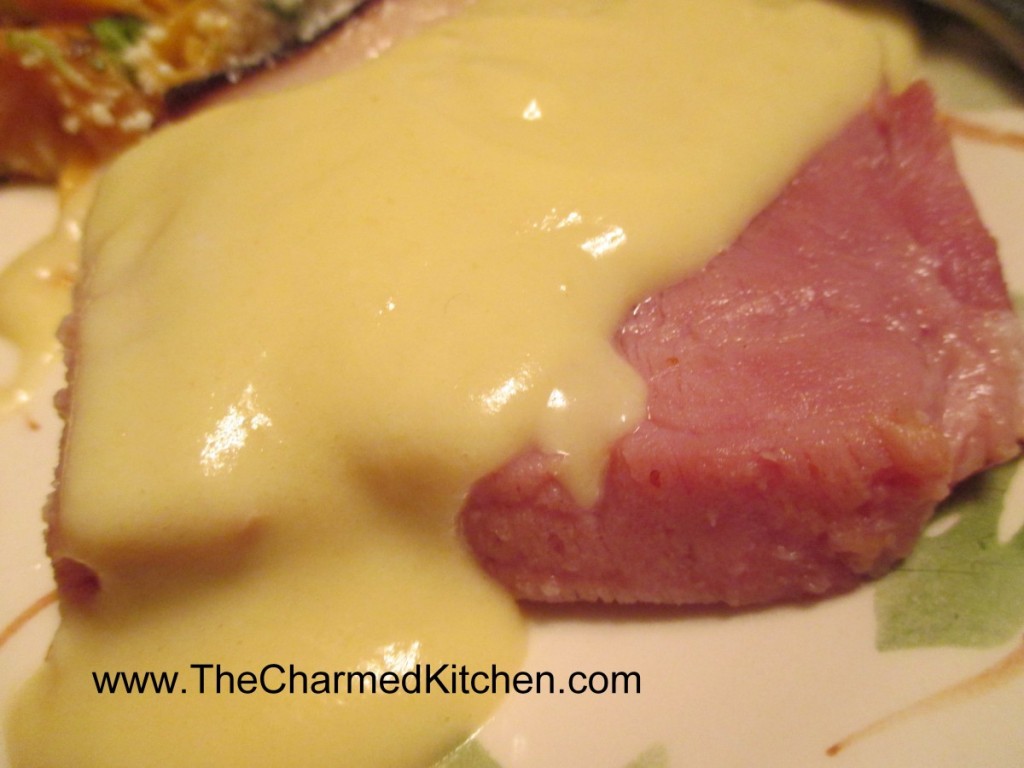
It is important to listen to your friends. My friend Kat kept telling me about her Grandmother Dienhart’s mustard sauce. She said it was a tradition in her family to always make it with ham. She told me how wonderful it was. She even sent me the recipe. She was so right. This stuff is amazing. Sweet, sour, creamy and just the right balance of flavors to pair up with the smoky flavor of ham. I could see this sauce becoming a tradition in my family, too.
While used on ham, it could be used with other smoked meats, roast beef, sausage, lamb or even duck.
Kat’s Extra Wonderful Mustard Sauce
3 large eggs
½ c. sugar
4 T. dry mustard
½ c. half and half
½ c. cider vinegar, warmed
4 T. butter
Off the heat, whisk eggs in the top of a double boiler. Sift in sugar and mustard powder. Whisk until smooth. Add half and half and place pot over simmering water. Heat mixture until it starts to bubble and thicken, while constantly whisking. Whisk in warm cider vinegar very slowly and stir until thickened. Stir in the butter until melted. Serve warm with ham. Makes 2 cups.
Coffee and Spice Rubbed Pork Roast

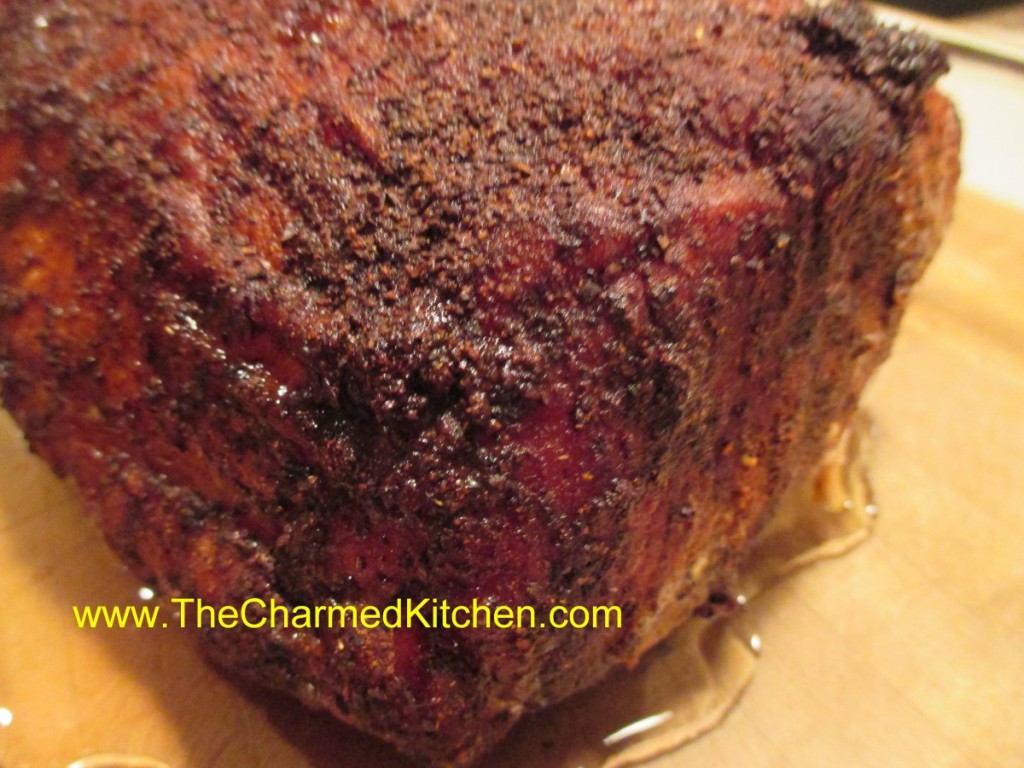
Since so many people are making a pork roast of some sort for the New Year, I thought I would re-post this recipe. I’ve had several requests for it in the last few days.
It is really good- with a rich blend of spices and coffee. The spice rub would also be great on lamb or beef. The rub can also be used on pork chops or ribs.
I am thinking of trying it on duck soon. Enjoy and Happy New Year!!
Coffee and Spice Rub
¼ c. ground coffee
¼ c. brown sugar
2 T. paprika
2 t. each cayenne pepper, cumin, garlic powder, salt and ginger
1 t. allspice
½ t. cinnamon
Combine all ingredients and stir to mix well. Store in a cool place, preferably in the refrigerator. Rub can be used on roasts or on chops, steaks and smaller cuts of meat. If using on chops that are being pan fried watch carefully as the sugar in the recipe could burn.
To use the rub: several hours before cooking, or even the day before, place the roast in a shallow pan and sprinkle heavily with the rub. Use your hands to spread it evenly and cover completely. Place plastic wrap on clean surface and transfer roast to the wrap. Fold plastic wrap to cover roast , using more plastic wrap as needed so meat is sealed well. Return to fridge for at least a couple of hours, or overnight. When ready to cook, bring roast out and allow to stand 30 minutes. Remove plastic wrap and place roast in a roasting pan on a wire rack.
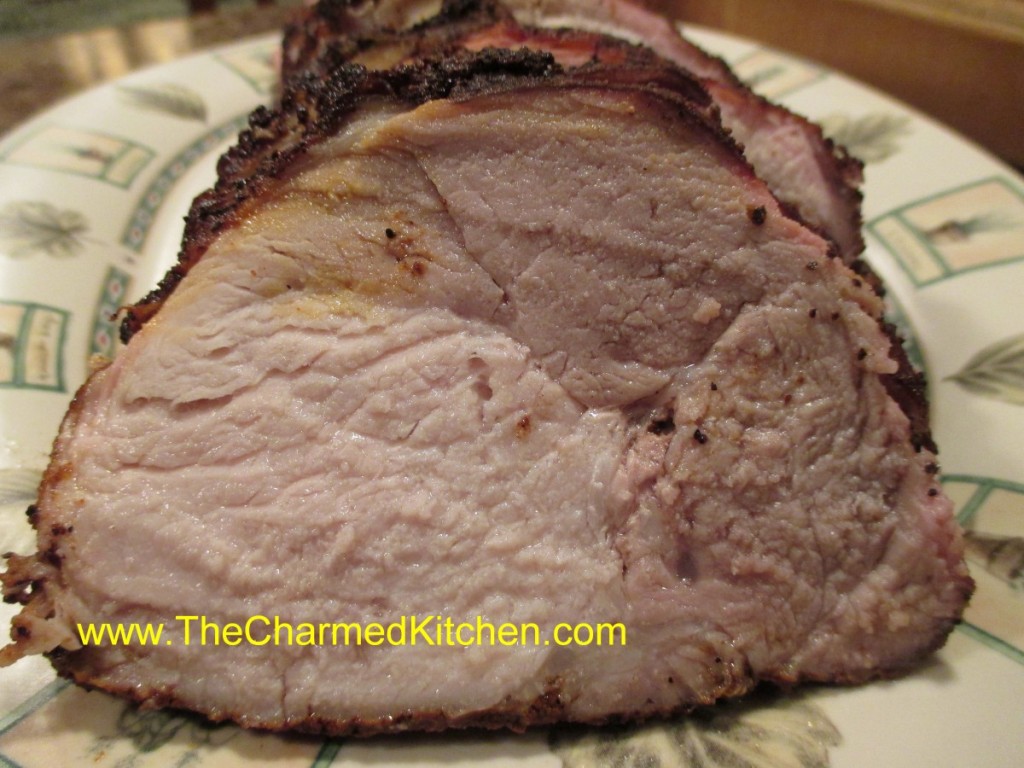
For the pork roast allow about 20 minutes per pound. Larger roasts need a little less time per pound. You want an internal temp of 145. Check with a thermometer, to be sure. You don’t want to overcook the pork. When the roast is finished- remove from oven and let stand 10 minutes, or a little longer, before slicing.
10 Easy Appetizers

If you are looking to serve appetizers for New Year’s Eve, or for other parties, here are some easy ones that your guests will love.
Some can be made ahead of time, saving you time the day of the party.
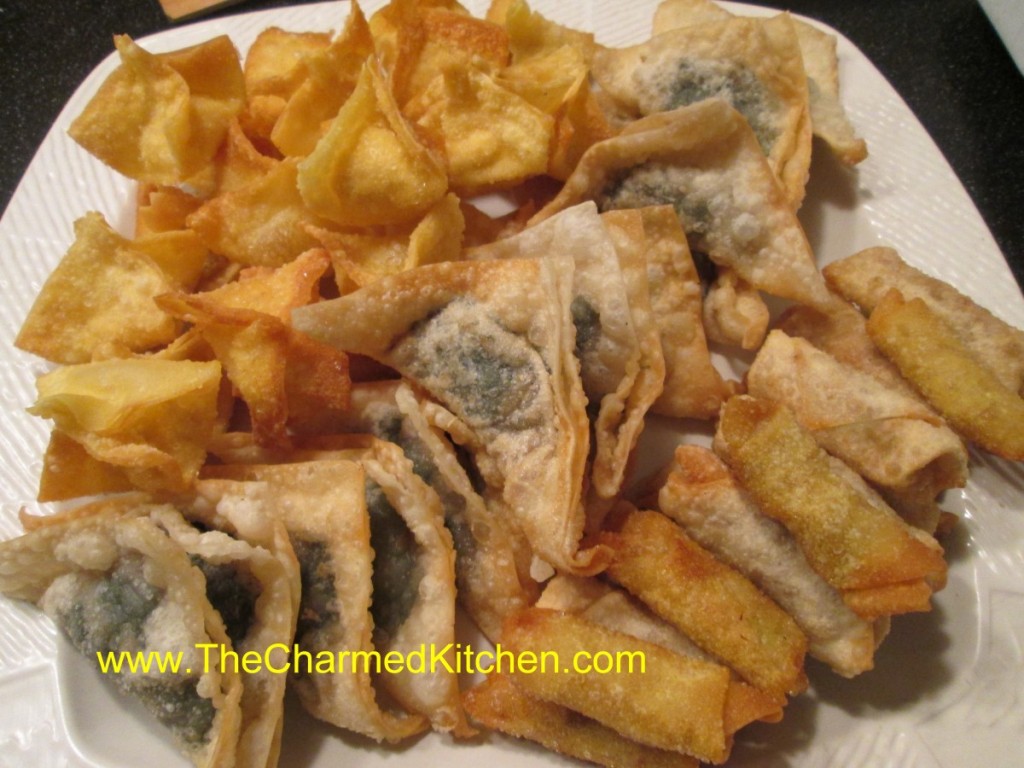
The won ton appetizers pictured here are from left to right- Crab Rangoons, Sesame Spinach Triangles and Honey Ginger Chicken Won Tons.
Sesame Spinach Triangles
oil
1 small onion, chopped fine
12 oz. fresh spinach, cooked, chopped and drained or 1 (10 oz.) box frozen spinach, thawed, cooked and drained
1/2 c. chopped water chestnuts
2 T. oyster sauce
2 t. sesame oil
1 t. hot sauce
won ton wrappers
Heat oil in skillet and cook onion until tender. Remove from the heat and stir in the remaining ingredients, except won ton wrappers. Adjust seasonings, if needed. Allow mixture to cool. Place 1 tablespoon of the filling in the center of a won ton wrapper. Moisten edges with a little water and fold over to form a triangle. Press to seal edges. Place filled triangles in 375 degree oil and fry for about 2 minutes or until golden.
Honey Ginger Chicken Won Tons
1 c. cooked diced chicken- I used thighs
1/4 c. minced celery
1/4 c. mayo
2 T. honey
2 T. dried minced onion
1 T. hoisen sauce
1 t. fresh grated ginger
salt and hot sauce to taste
won ton wrappers
Combine all ingredients, except the wrappers, and mix well. Place 2 teaspoons of filling in the center of each won ton wrapper. Moisten edges with a little water. Fold in 2 corners to meet in the middle. Starting at one of the remaining corners fold up and over and form into a roll. Press to seal edges. Fry in hot oil ( 375 degrees) for 1-2 minutes or until golden brown.
Crab Rangoons
1 clove garlic, minced
1 (8 ounce) package cream cheese
1 (6 ounce) can crab meat, drained and flaked
2 green onions with tops, thinly sliced
2 teaspoons Worcestershire sauce
1/2 teaspoon light soy sauce
won ton wrappers
Combine all filling ingredients and chill until ready to use. Place 2 teaspoons of filling onto the center of each wonton skin. Moisten the edges with water and bring 2 corners together. Bring the other 2 corners up and press all together to seal. Press all seams to seal. It should look like a little bundle. Fry in hot oil until golden brown, about 1-2 minutes.
Hot Crab Dip
8 oz. crab meat or faux crab, if you prefer
8 oz. cream cheese
1/2 c. mayo
1 T. chopped chives or green onion, optional
1 heaping teaspoon horseradish
1/2 t. Worcestershire sauce
1/4 t. hot pepper sauce, or to taste
Combine all ingredients in ovenproof bowl and mix until smooth. Bake in a 300-degree oven for 25-30 minutes or until hot and bubbly. You can also heat mixture in microwave for 90 seconds or until hot. You can mix the ingredients ahead of time and chill until ready to heat and serve. Serve with crackers, crusty breads or veggies. You can also spoon mixture into hollowed out tomatoes and broil until crab dip is hot and bubbly.
Pineapple Glazed Chicken Wings
12 chicken wings, cut into 2 pieces, save tips for another use
1 medium onion, chopped
1 can (or jar) of pineapple chunks, drained, reserving liquid- I used a pint jar- if using store bought use the 20 oz. can.
salt and pepper
Sauce:
1/2 c. apple cider vinegar
1/2 c. sugar
3 T. ketchup
3 T. sherry
2 T. soy sauce
1 t. minced garlic
1 t. red pepper flakes
reserved pineapple juice
3 T. cornstarch
Preheat oven to 400 degrees. Place wings in pan and season with salt and pepper. Bake chicken wings in roasting pan for 30 minutes. Add the onions and pineapple chunks to the pan with the chicken wings and return to the oven for 30 minutes longer. While chicken is cooking combine the first seven sauce ingredients in a small pot and bring to a boil. Check baking pan for any juices- Spoon them out and add to the sauce. Combine pineapple juice and cornstarch in small bowl, stirring until smooth and add to the sauce. Return to boil and stir until sauce is thickened and bubbly. Pour hot sauce over chicken and return to the oven to bake 20-30 minutes longer or until wings look nicely glazed and sauce has started to brown. Makes 24.
Brie Truffles
8 oz. brie, room temperature- I remove the rind from the brie for a smoother texture.
8 oz. cream cheese, softened
1 stick ( 4 0z.) butter, softened
2 c. fresh pumpernickel bread crumbs*
In food processor combine cheeses with butter until smooth. Chill mixture 30 minutes or longer. With a small cookie scoop or teaspoon form mixture into small balls. Place crumbs in a bowl and roll the balls of cheese in the crumbs to coat. Place in small paper cups and chill until ready to serve. Makes 3-4 dozen.
* To make the crumbs just place torn
Caramelized Onions “Toasts”
2 lbs. Onions, chopped
3 T. oil
1 t. salt
2 T. brown sugar
¼ c. balsamic vinegar
Dash red hot pepper sauce
Paprika
Sauté onions in oil with salt over low heat for 25-30 minutes. Onions should begin to caramelize and brown without burning. Add remaining ingredients and cook slowly another 15 minutes. Adjust seasonings, if needed and serve warm with crusty bread, crackers or smoked meats. Keeps in fridge for a couple of weeks or can be frozen. To make the toasts I placed a little of the onions on Wheat crackers and topped with squares of sliced Swiss cheese. Placed in a 400 degree oven until the cheese melted.
Brie with Pesto and Sun-Dried Tomatoes
2 c. basil leaves
3 T. Pine nuts, walnuts or pecans
2 T. olive oil
2 cloves garlic
3 T. Parmesan cheese
salt and pepper to taste
½ c. sun-dried tomatoes, soaked in water and chilled overnight
1 T. oil
1 t. oregano
small wheel of Brie 1-2#
Combine first five ingredients in a blender or processor until smooth. Add salt and pepper to taste. Drain tomatoes and chop coarsely. Combine with remaining oil and oregano and season to taste. Split Brie horizontally into 3 pieces. Spread
One layer with pesto and top with a piece of Brie. Spread with tomato mixture and top with remaining Brie. Wrap and chill overnight. Serve at room temperature or warm slightly. I warmed it wrapped in foil at 400 degrees for 10 minutes.Wanted it to brown a bit. Goes best with crusty breads.
Caponata
2 small eggplants, unpeeled and cut into 1/2-inch pieces, about 5-6 cups
1 large onion, chopped
1/2 c. olive oil, or a little more
4 celery ribs, sliced
2 sweet peppers, seeded and chopped
1 heaping tablespoon chopped garlic
3 tomatoes, chopped- or 1 (14.5) can diced tomatoes- undrained
1 c. sliced black olives
3-4 T. red wine vinegar
salt and pepper to taste*
Soak eggplant in salted water for at least 15 minutes. Rinse, drain and pat dry. Set aside. Meanwhile in skillet cook onion in 2 tablespoons of the oil until tender. Add the celery and cook until the celery is tender-crisp. Place mixture in a mixing bowl and set aside. Heat 2 tablespoons more of the oil and cook the peppers until tender. Add garlic and cook 1 minute longer. Add the tomatoes and cook 1 minute longer. Add this mixture to onion mixture and return skillet to the heat. Add remaining oil to skillet and cook eggplant until golden brown and tender. You may have to do this in 2 batches. Add remaining ingredients to bowl while eggplant is cooking. When eggplant is done add it to the bowl and mix well., Season to taste. Serve with crusty breads cold, hot or at room temperature. Serves 10-12.
* While I don’t have any herbs listed in the ingredients I often add oregano and basil or an Italian or Tuscan seasoning blend. I also like to add capers.
Mushroom Spread
½ lb. mushrooms, trimmed, washed and chopped
2 T. butter or oil
1 medium onion, chopped
½ t. salt
Fresh ground pepper
Dash of nutmeg
1 t. lemon juice
2 t. flour
½ c. sour cream or strained yogurt
½-1 t. dill weed
Sauté onions and mushrooms in butter or oil for 4 minutes. Add seasonings, lemon juice and flour and cook 3 minutes more. Remove from heat and stir in sour cream or yogurt and dill. Serve with pumpernickel bread, crackers or in mini cream puff shells.
Angel Wings / Chruschiki


Angel Wings are what a lot of people call these fried, delicate cookies. In my family, we also call them Flancate (Slovenian) or Chruschiki (Polish). After posting a picture on Facebook, I learned they have even more names. Many nationalities make versions of these cookies. We made them in class the other night and everyone enjoyed them.
The dough is a mixture of 8 eggs yolks, white wine, a little salt and flour. Very similar to pasta dough. They are a tradition in my family. I try to make them at least once during the holidays.
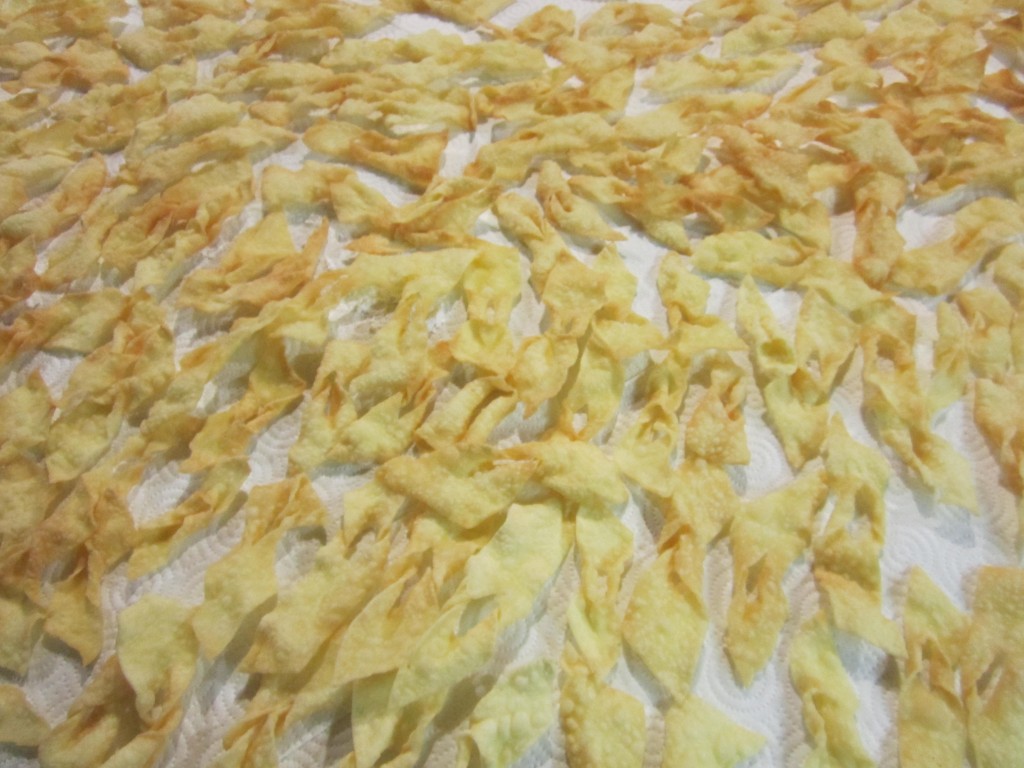
I use a pasta machine to roll out the dough. You can roll them out by hand, but a pasta maker makes the job a lot faster and easier. Also, if the cookies sit around and start to dry out before you can fry them, they tend not to grow as much. They are cut, shaped then fried. They puff up a lot when fried. More than doubling in size.
Once cooled, they are dusted with powdered sugar. Because they are rolled so thin, a single batch can make a hundred cookies or more.
Part of the fun of making them, is watching someone eat one for the first time. They are delicate and will sometimes fall apart when you go to bite into one. Then there is the powdered sugar. Let’s just say you don’t want to be wearing black.
Angel Wings/ Flancate / Chruschiki
8 egg yolks
2 ½ -3 c. flour, plus extra for rolling
½ c. white wine – I sometimes use sherry
1 t. salt
oil or shortening for deep frying
powdered sugar for sprinkling
Combine egg yolks, wine and salt mixing until smooth. Stir in 2 cups of the flour and continue adding flour until dough is very firm, but still pliable. It is better to add more flour later than to add too much too soon. Knead or mix the dough in a mixer for 5-8 minutes. Kneading dough, or mixing in a stand mixer strengthens the dough. Divide dough into thirds, cover and allow to rest 1 hour.
On lightly floured surface, roll dough out into thin strips. Cut strips diagonally into 1 ½ inch wide pieces. Cut a small slit in middle of dough and pull one end through, pulling until dough is long and somewhat twisted. Work with small amount of dough at a time to avoid drying out. Dry dough will tear and be hard to work with. You can use a pizza cutter or a pastry wheel with a zigzag edge. Cook dough, a few pieces at a time in a skillet with either oil or shortening 2 inches deep and heated to a temperature of 375 degrees. Pastry will cook in 30 seconds or so. Remove when lightly brown and drain on paper toweling. Cool and dust with powdered sugar. Makes at least 100, depending on how thin you can roll them. We have gotten as many as 200 from a single batch.
Note: If you have access to a pasta machine, the rolling time will be greatly reduced. Use the machine to roll the dough uniformly and quickly. There is no substitute for experience. After making a batch you will learn just how the dough should feel and how thick to roll the dough. If too thick, the dough is not as tender. Too thin and they fall apart to easily. Also, get a friend or two to help you. The are a lot of jobs to do and the time will fly with some assistance. Besides, you’ll have plenty to share with family and friends.
Two Trees and a Roll of Duct Tape


I have some really fun childhood holiday memories. Perhaps the most fun was getting our own Christmas tree. What really made the trip fun was going with Uncle Frank.
Uncle Frank was my dad’s baby brother. He was always so much fun. He had a great sense of humor, too.
The one thing Uncle Frank never seemed to have- at least at tree cutting time- was a car with a working heater. I am not sure if he and my dad thought it was more of an adventure that way. I mean, we could have gone in my family’s car- but we never did.
One year in particular, will always stand out for me. There were 7 of us in a Volkswagen beetle. Two adults, my Dad and Uncle Frank, three of my cousins, my brother and me. Of course, no heater in the car. It was also a very snowy December, so the car was cold.
We were all bundled up as we headed out to get a couple of Christmas trees. There is a small space behind the back seat in an old Beetle. That is where my cousin Laurie and I sat. My brother and two cousins shared the back seat. Dad and Uncle Frank sat in front.
When we got to the tree farm, the dads pretty much left us kids on our own. There was a lot of snow on the ground and I remember sliding down a snowy hill, over and over. When we were called back to the car- we were all pretty cold- and our boots were full of snow.
I don’t want you to think that my Dad and Uncle Frank were not good parents or reckless. They were the best- and so much fun. They insisted we all take off our wet boots when we got in the car. Everyone tossed them in the area in back were Laurie and I had been sitting. We joined the others in the back seat. My cousin Gary sat on my Dad’s lap. Well, that was after my Dad and Uncle Frank got in the car.
See, there was this problem with the trees. For some reason they didn’t have enough rope- or any rope. I don’t really remember that part.
I just know, that at some point, with the kids shivering in the car- we were now wet and had removed our boots- My Uncle Frank and my father started taping two pine trees to a VW Bug. I remember them passing the tape over and under the car, making sure the trees were not going anywhere.
I feel the need to point out, that the rounded top of the beetle was not an easy place to secure a tree- or two. So the trees ended up more on the sides of the car, taped securely into place. I learned at a very early age, the value of duct tape. The guys had to come in through open windows, since the trees were pretty much blocking the doors.
When my Uncle started up the car- the windows were all frosted up. The heater did not work, so no defroster for the windows. He used his thumbnail to scratch off an area of ice about the size of a silver dollar. He closed one eye, put the open eye up to the little circle he had cleared on the windshield and declared – it was fine- he could see just fine.
We all laughed. He was laughing, so was my Dad. We took our cues from the adults and joined in the merriment. It was a cold, but laughter- filled ride home. When we got back, my uncle crawled out the window and un-taped the trees so we could all get out of the car.
My Mom and Aunt quickly got us into dry clothes and I am guessing they were not as amused by our condition as we were. The point is, no one got hurt and it probably toughened us up a little.
I am glad there are car seats and seat belts and air bags in cars today. I think kids and adults should be safely secured in all moving vehicles. But way back when- we didn’t have those safety features. It isn’t like they decided not to strap us in- they couldn’t.
While my Uncle Frank was laughing and joking around that day, he was also a police officer. I am sure he knew how to drive in snowy conditions. Maybe he was nervous. Maybe my dad was, too. But if they were, they didn’t show it.
I know there was a lot of love and laughter in the Beetle that day. I can only imagine the looks we got from other drivers on our way home. I couldn’t actually see other cars, however, as the view was blocked by the tree branches and frosty windows.
If there is any lesson- perhaps it is to be brave enough to be silly sometimes. While I don’t want anyone to put a child in harm’s way- don’t be so careful that your kid’s miss out on adventures, too.
Be the person that gives a kid a really good memory this holiday season. Perhaps, using duct tape and a couple of trees.
Candied Orange Peels

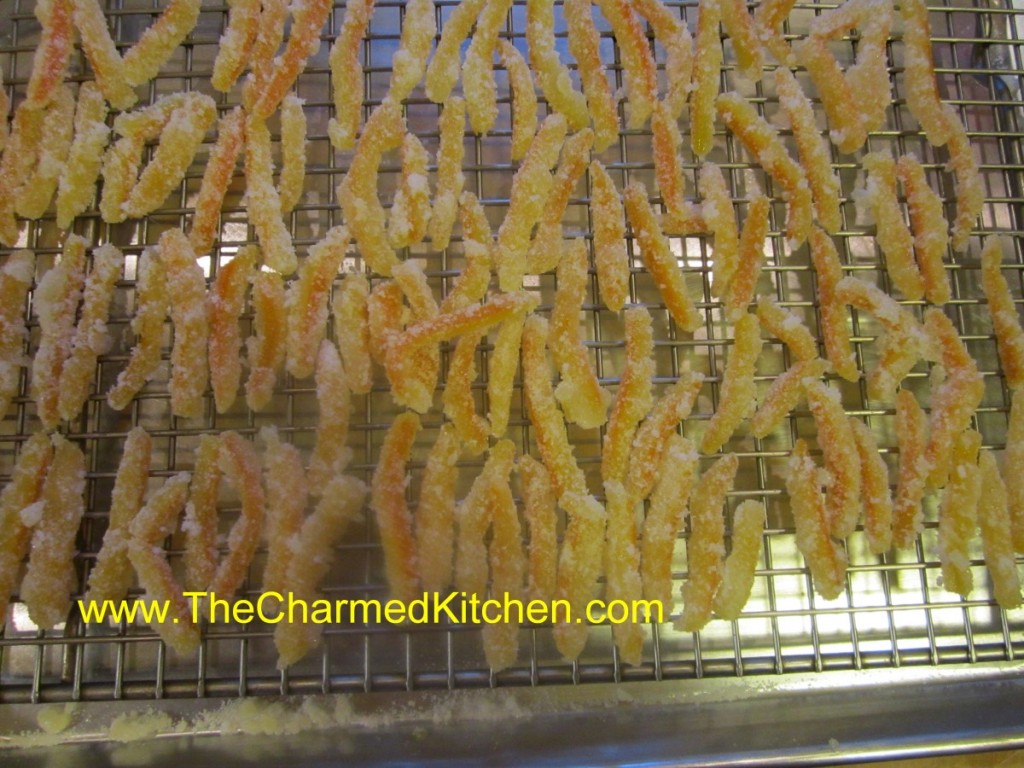
During the winter months, when citrus is in season, I find myself eating a lot of oranges. I also find myself with a lot of orange peels. I dry some and powder them up for use in baking and cooking. Another fun use for orange peels is to turn them into a candy.
Candied orange peels are pretty easy to make and a nifty way of turning something that might otherwise be discarded into something tasty. You can also candy other citrus peel this way like grapefruit and lemons. The same process can be used to make candied ginger. Best to use organic oranges, since you are eating the peels.
Once finished, the candied peels can also be dipped in dark chocolate for a special treat.
They make a nice gift, too.
Candied Orange Peel
2 large oranges ( you can also use 1 grapefruit or 3 lemons)
or 1 lb. of ginger root*
¾ c. water
¾ c. sugar, plus extra for rolling
3 T. light corn syrup, optional
Remove peel from fruit using a sharp knife. Try to get the peel off in 4 pieces. Cut the peel into ¼-inch wide strips. Place peel in a pot with cold water and bring to a boil. Boil 1 minute, drain and rinse under cold water. Repeat process 2 more times. Return to pan with fresh water and boil 15 minutes. Drain and pat dry. Bring ¾ c. water and ¾ c. sugar to boil in sauce pan with the corn syrup. Boil 2-3 minutes and then add the peel. Simmer, stirring occasionally until all but a spoonful of the syrup is left. This should take about 10 minutes. On a wax-paper lined baking sheet sprinkle 1 cup of sugar and arrange the peels on top of the sugar. Toss the peels around until cooled adding more sugar if needed. Place peels on a drying rack for 24 hours before storing. Once dried you can also dip one end of the peels in dark chocolate. Makes ½ pound.
* If making the candied ginger root, peel and cut into 1/4- inch slices. Then cut the slices into 1/4-inch thick strips